Facial Implants
3D Accuscan Patient-Specific® Facial Implants
To address a number of issues, surgeons and patients alike choose to use facial implants made of silicone. These issues include flat cheeks, a weak jaw line, a recessed chin, dark circles from bags under the eyes, hollowed temples, nasal deformities and so on.
Silicone facial implants offer volume in a soft, flexible format that does not resorb into the body. As such, they can provide long-lasting shape and yet, should the need arise, they can be easily removed.
Whether the basis for using a silicone facial implant is reconstructive or cosmetic, those in need can benefit from its transformative augmentation along with a natural look and feel.
Generally, an inventory of implants in a variety of styles and sizes is sufficient for a majority of indications.
However, there are numerous cases in which a stock implant just won’t do.
For example, patients sometimes present with irregularly shaped defects that no typical implant will fit. They thus require what are essentially tailor-made, or, patient-specific implants.
According to Barry L. Eppley, MD, DMD, designer of several facial implants, another compelling reason for using patient-specific implants is that they “create an aesthetic effect that standard implants cannot. This generally means such implants cover greater bone surface areas than standard implants to create a more notable facial change. This does not necessary mean they are always ‘bigger’ (thicker), but they do almost always cover a greater amount of bone surface.”
One way to create a patient-specific implant is with a silicone moulage kit. A casting (or, moulage) is created of the patient’s defect, then the silicone implant is made from the casting.
While such a moulage can approximate the defect, a notably more exacting approach is that of the 3D Accuscan® system.
3D Accuscan® for patient-specific implants
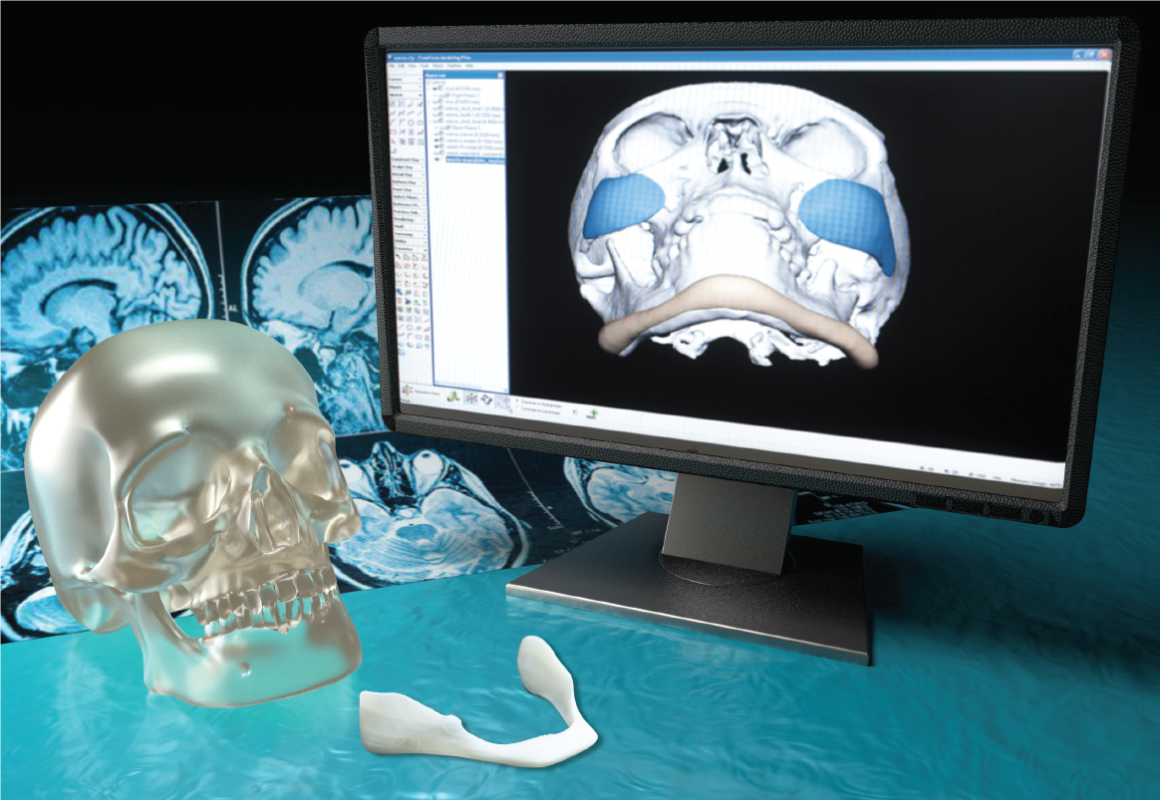
Taking advantage of medical imaging and computer modeling, the 3D Accuscan® system essentially permits surgeons to create a tailor-made implant.
The process begins with making a three-dimensional digital model of the patient’s CT scans. Subsequently, in an online meeting, the surgeon works with a 3D Accuscan technician to design a virtual implant exactly as envisioned.
Results are seen in real time every step of the way, with the virtual implant viewable in 360 degrees. When the surgeon is satisfied with the design, the implant is faithfully recreated in first a PDF and then a sample if requested.
After the surgeon approves the PDF and sample, the surgeon receives the actual patient-specific implant made of solid silicone.
Ultimately, various individuals—particularly those with deformities or reconstructive needs—can benefit from a patient-specific implant as their only viable option. And, as Dr. Eppley notes, “People today are much more interested in a personalized approach to their implant design. The ability to see what their implant will look like and even to participate in the design is a very attractive feature of the patient-specific process.”